Fat Loss & Macro Coaching
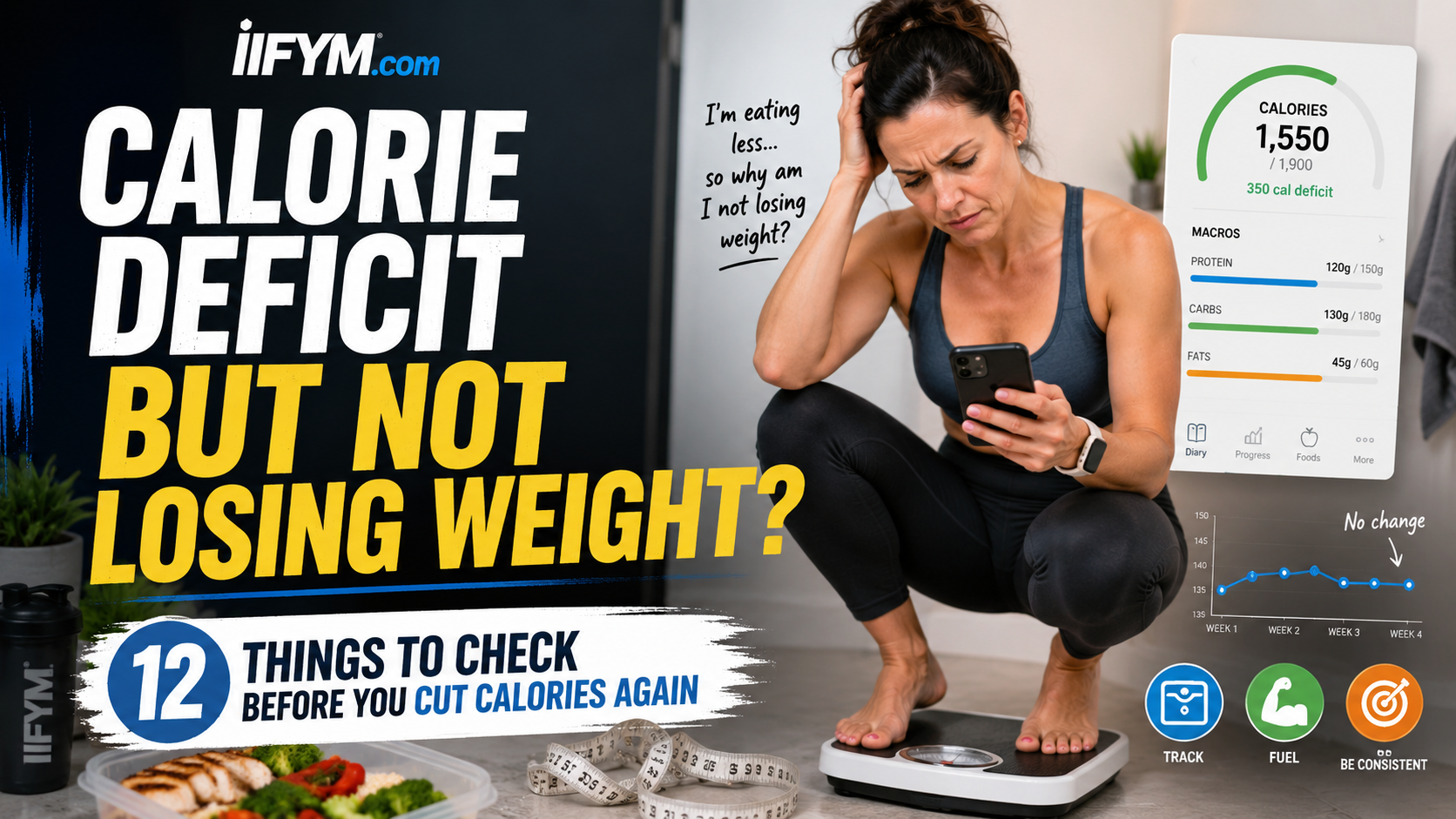
Why Am I Not Losing Weight in a Calorie Deficit? 12 Things to Check Before Cutting Calories Again
You’re tracking your food. You believe you’re in a calorie deficit. Maybe the plan was working for weeks or months. Now the scale won’t move. Before you cut another 200 calories or add more cardio, work through these 12 checks in order.
By Anthony Collova, Founder of IIFYM.com
Originally published:
Substantially reviewed and updated:
Quick answer: If your scale isn’t moving, it doesn’t automatically mean fat loss has stopped. Short-term changes in water, glycogen, digestion, sodium, training inflammation, and the menstrual cycle can hide changes in body fat. If the stall is real and sustained, your actual energy deficit may also be smaller than you think because intake, body weight, activity, hunger, and energy expenditure change over time.
The mistake is assuming the answer is always “eat less.” First determine which problem you actually have.
Important Medical Note
This article is general education about weight management and macro coaching. It isn’t medical advice, diagnosis, or treatment.
Medical conditions, medications, pregnancy, menopause symptoms, eating disorders, and other health factors can influence body weight, appetite, fluid balance, activity, and the safety of a calorie deficit. Talk with an appropriately qualified healthcare professional when medical assessment or medical nutrition therapy is needed.
There are few things more frustrating than doing everything you think you’re supposed to do and watching the same number show up on the scale.
You start wondering if your metabolism is broken. You question whether calories even matter. Or you decide the only possible solution is to eat less and exercise more.
Slow down.
Weight loss isn’t perfectly linear, and the scale doesn’t measure body fat. It measures your total body mass at that moment, including water, glycogen, food in your digestive system, waste, lean tissue, and fat.
At the same time, a calorie deficit isn’t a fixed number you earn by typing your information into a calculator. Your energy needs change as your body weight, activity, food intake, training, and behavior change.
The NIH Body Weight Planner was developed around this exact reality. The body responds dynamically to changes in calorie intake and activity, which is why the old idea that a fixed 3,500-calorie deficit will produce exactly one pound of weight loss forever is too simplistic. The National Institute of Diabetes and Digestive and Kidney Diseases explains the model here.
So when someone tells me, “I’m in a calorie deficit but I’m not losing weight,” I don’t immediately assume they’re lying, failing, or metabolically broken.
I start investigating.
Can You Be in a Calorie Deficit and Not Lose Weight?
We need to separate fat loss from scale loss.
By definition, a sustained energy deficit means your body has to make up the energy difference from stored energy. But that doesn’t guarantee the bathroom scale will decrease every day or every week.
Water retention alone can temporarily mask fat loss. So can glycogen changes, constipation, menstrual-cycle fluctuations, changes in sodium or carbohydrate intake, and inflammation from hard training.
There’s another important distinction: you can believe you’re in a 500-calorie deficit without actually being in one. Calorie calculators, watches, exercise machines, nutrition labels, restaurant estimates, portion sizes, and food logs all involve some degree of estimation.
And the calorie intake that created a meaningful deficit 20 pounds ago may create a much smaller deficit today because a smaller body generally requires less energy. Weight loss itself can also reduce resting and non-resting energy expenditure. A clinical review in StatPearls describes these adaptations in detail.
Remember: “My scale didn’t move” and “I lost no body fat” are not always the same statement. Before changing the plan, figure out which one you’re dealing with.
What Counts as a Real Weight-Loss Plateau?
A few flat weigh-ins aren’t enough for me to call something a true fat-loss plateau.
Body weight naturally moves up and down. Mayo Clinic notes that early weight loss often includes changes in glycogen and water, and that weight loss commonly slows as body mass and energy needs decrease. Read Mayo Clinic’s explanation of weight-loss plateaus here.
Instead of reacting to a single number, look for a pattern.
I want to know:
- Is the weekly average actually flat?
- How long has it been flat?
- Are waist measurements or clothing fit changing?
- Is the person menstruating, constipated, traveling, or unusually sore?
- Did training volume increase?
- Did sodium or carbohydrate intake change?
- Has average daily activity changed?
If you react to every temporary fluctuation by lowering calories, you can turn a perfectly workable diet into an unnecessarily aggressive one.
12 Things to Check Before You Cut Calories Again
1. Make Sure Your Weight Loss Has Actually Stalled
Start with the boring answer because it’s often the correct one: you may need more data.
If your weight was 172.0 on Monday and 173.4 on Friday, that doesn’t tell me you gained 1.4 pounds of body fat. The comparison is too noisy.
Look at trends instead of isolated weigh-ins. A rolling weekly average can make the signal much easier to see.
Also look beyond the scale. Waist measurements, progress photos, clothing fit, strength, and other body-composition indicators can give useful context when scale weight is temporarily distorted.
Before changing anything: Ask whether the trend is truly stalled or whether you’re reacting to normal scale noise.
2. Check for Water Retention Before Assuming Fat Loss Stopped
Your scale can hold steady while body fat is decreasing because fat isn’t the only thing affecting your weight.
Hard training can increase temporary inflammation and water retention. A high-sodium restaurant meal can move scale weight. More carbohydrates can increase stored glycogen and the water stored with it. Constipation can also change scale weight without changing your body fat.
This is one reason aggressive low-carb diets can create dramatic early scale changes. Mayo Clinic notes that glycogen is stored with water, so some early weight loss after reducing calories or carbohydrates reflects water rather than body fat. Mayo Clinic discusses that effect here.
If nothing about your food intake or activity suggests fat gain, don’t panic over a short-term increase.
3. Audit Your Tracking Without Shaming Yourself
Tracking errors are common because food tracking is harder than people think.
Cooking oils, dressings, creamers, alcohol, bites while cooking, restaurant meals, incorrect database entries, cooked-versus-raw weights, and eyeballed portions can all create a gap between what the app says and what you actually ate.
This doesn’t mean you’re lying.
It means the data needs an audit.
IIFYM already has a full guide to the most common macro-tracking mistakes. If you believe you’re doing everything right but the numbers don’t make sense, start there before cutting food.
Good coaching investigates accuracy without turning the client into the enemy. Shame makes people hide information. Curiosity gives us better data.
4. Look at the Whole Week, Not Just Monday Through Thursday
A calorie deficit is created over time.
Someone can be extremely consistent for four or five days and unknowingly erase much of the weekly deficit with restaurant meals, alcohol, grazing, larger portions, or untracked weekend meals.
This is especially common when weekday calories are too aggressive. The person spends the week white-knuckling hunger, then assumes the weekend overeating is a discipline problem.
Sometimes the real problem is program design.
Your weekly pattern matters more than having four “perfect” days.
5. Stop Treating Exercise-Calorie Estimates as Exact
A smartwatch or cardio machine can be useful for consistency, but its calorie-burn estimate isn’t a receipt you can automatically eat back.
Your true total daily energy expenditure includes resting energy expenditure, the thermic effect of food, structured exercise, and non-exercise activity. All of those can vary.
The NIDDK Body Weight Planner exists because energy expenditure and body weight change dynamically rather than according to a perfectly fixed equation. You can review the NIH Body Weight Planner here.
Use calorie-burn estimates as estimates, not guarantees.
6. Check Whether Your Daily Movement Quietly Dropped
This one gets missed all the time.
When people diet for a while, they may move less without deliberately deciding to move less. They sit more, fidget less, take fewer spontaneous trips across the room, and feel less energetic.
Non-exercise activity thermogenesis, often shortened to NEAT, is part of total daily energy expenditure. Clinical reviews of weight-loss plateaus describe reductions in both resting and non-resting energy expenditure as body weight falls. See the StatPearls review on weight-loss plateaus.
Compare your average steps and general activity now with what they were when the diet was working.
You may not need more cardio. You may simply need to stop an unnoticed drop in normal movement.
7. Remember That a Smaller Body Usually Burns Fewer Calories
If you’ve lost a meaningful amount of weight, your maintenance calories may be lower than they were when you started.
A 200-pound body and a 165-pound body don’t have identical energy requirements. The old calories may still be producing a deficit, but the deficit may now be smaller.
This is normal physiology, not evidence that your metabolism is ruined.
NIDDK specifically notes that metabolism slows during weight loss and that the body generally needs fewer calories at a lower body weight. Read NIDDK’s weight-management guidance here.
8. Consider Metabolic Adaptation Without Calling Your Metabolism “Broken”
Metabolic adaptation is real.
It also gets exaggerated online.
During weight loss, total energy expenditure can decrease for several reasons. You weigh less. You may move less. Resting energy expenditure can decline. Hunger can increase. Your body becomes more efficient at operating under reduced energy intake.
That doesn’t violate energy balance, and it doesn’t mean fat loss has become physically impossible.
It means the size of the deficit can change over time.
The NIH’s body-weight modeling work specifically rejects the idea that the body responds to a calorie change with a perfectly fixed, linear amount of weight loss. NIDDK explains why here.
Your metabolism can adapt without being damaged. Those are two very different ideas.
9. Ask How Long You’ve Been Dieting and How You’re Functioning
If you’ve been in a deficit for months, I want more information than your scale weight.
How hungry are you? How are you sleeping? What’s happening in the gym? How’s your mood? Are you thinking about food all day? Have your steps dropped? Are you still able to follow the plan consistently?
Sometimes the technically obvious answer is to reduce calories again.
Sometimes the smarter answer is to stop dieting for a period of time and return to a structured maintenance intake before attempting another fat-loss phase.
A diet break isn’t magic and doesn’t “reset” the laws of thermodynamics. It can, however, provide a structured period away from the deficit when diet fatigue, adherence, training, and quality of life are becoming problems.
For more on that decision, read Diet Breaks: When and How to Use Them.
10. Look at Sleep Because It Can Change the Difficulty of the Deficit
Poor sleep doesn’t magically cancel a calorie deficit.
But it can make staying in one harder.
Sleep restriction can affect appetite, cravings, energy, and behavior. In a randomized clinical trial highlighted by the NIH, adults with overweight who extended their sleep took in fewer calories on average during the intervention. Read the NIH summary here.
So when a client tells me their sleep has fallen apart, I don’t dismiss it because “calories are all that matter.”
Calories matter. So does the person who has to consistently adhere to them.
11. If You Menstruate, Compare the Same Parts of Your Cycle
Menstrual-cycle changes can temporarily alter scale weight.
A 2023 study found body weight was about 0.45 kg higher during menstruation than during the first week of the cycle in the women studied, with the difference largely attributed to extracellular water. You can read the PubMed abstract here.
That doesn’t mean every woman will see the same change.
It means comparing this Tuesday with last Tuesday can sometimes be less useful than comparing similar phases of the menstrual cycle.
Hunger, cravings, energy, and training can change too. A good coach should recognize the pattern instead of treating every temporary increase as evidence that you failed.
12. Know When the Problem Belongs in a Medical Conversation
Nutrition coaching has limits.
Medicines, medical conditions, hormonal changes, age, sleep, and other factors can affect weight management. The CDC specifically notes that medicines, medical conditions, stress, genes, hormones, environment, and age can influence weight management. See the CDC’s current weight-loss guidance.
If your weight trend doesn’t make sense after a careful review of intake, activity, and time, or you have new or concerning symptoms, talk with a healthcare professional.
That’s especially important when the plateau appears alongside symptoms such as unusual swelling, significant fatigue, major menstrual changes, persistent gastrointestinal symptoms, or a recent medication change.
A coach should know when to coach and when to refer out.
What I Actually Change When a Client Is Truly Plateaued
This is where generic weight-loss advice usually becomes too generic.
I don’t have one automatic response to a plateau.
I first want enough data to believe we’re dealing with a real plateau rather than normal scale fluctuation. Then I verify adherence, current intake, weekly patterns, steps, training, hunger, sleep, digestion, stress, and how long the person has been dieting.
Only then do I decide which lever, if any, needs to move.
Depending on the situation, I may:
- Leave the macros exactly where they are and collect more data
- Correct a tracking or weekend-consistency problem without lowering food
- Restore daily activity that quietly declined
- Make a small adjustment to carbohydrate and/or fat intake
- Keep protein appropriately supported while adjusting the other macros
- Use a refeed or structured diet break when the situation calls for it
- Move the person to maintenance instead of pushing the deficit harder
- Refer them to a physician or registered dietitian when the issue is outside coaching scope
What I don’t do is punish a stalled scale.
Dropping 300 calories and adding an hour of cardio is easy. Figuring out whether that’s actually the right decision is coaching.
Remember: The goal isn’t to make the diet harder. The goal is to make the smallest effective change that gets the right process moving again.
Women: Menstrual Cycle, Perimenopause, and Menopause Deserve Context
Women are often given two equally unhelpful messages.
One side says hormones explain everything. The other says hormones are irrelevant because “a calorie is a calorie.”
Neither is good coaching.
Menstrual-cycle water changes can temporarily mask scale progress. Perimenopause and menopause can also affect the dieting experience through changes in symptoms, sleep, body composition, activity, and other factors.
The American College of Obstetricians and Gynecologists notes that menopause hormone therapy by itself isn’t a weight-loss treatment, but it may improve symptoms such as night sweats that interfere with sleep, and poor sleep can affect weight control. Read ACOG’s current guidance here.
Your body changing doesn’t mean energy balance disappeared.
It means a good plan needs to consider the body and life you have now, not the ones you had 15 years ago.
When Should You Talk With a Healthcare Professional?
Talk with your physician or another qualified healthcare professional when you’re concerned that a medical condition or medication may be influencing your weight, appetite, fluid retention, energy, or ability to exercise safely.
Seek professional guidance before using a very-low-calorie diet, making major dietary changes during pregnancy or breastfeeding, or attempting to self-treat a medical condition through macros.
People with a current or previous eating disorder should also work with appropriately qualified professionals when weight-loss efforts or tracking may aggravate disordered eating patterns.
The job of a good coach isn’t to pretend to be your doctor. It’s to recognize when the next step requires one.
What Not to Do When the Scale Stops Moving
A plateau can make intelligent people panic.
Try not to respond by stacking every possible intervention at once.
- Don’t slash calories after three flat weigh-ins.
- Don’t automatically eliminate carbohydrates.
- Don’t double your cardio before reviewing your normal activity.
- Don’t dehydrate yourself or manipulate sodium to force the scale down.
- Don’t assume one high weigh-in means you gained fat.
- Don’t assume your metabolism is “broken.”
- Don’t assume you failed.
Change one thing for a reason, then collect enough data to know whether it helped.
Anthony’s Coaching Note
When someone comes to me saying, “I’m in a calorie deficit but I’m not losing weight,” the worst thing I can do is make them prove how miserable they’re willing to become.
I want to know what they’re eating now, what they were eating before, what results those numbers produced, how accurately they’re tracking, what their activity looks like, how long they’ve been dieting, what’s happening with sleep and stress, and whether there’s a pattern we’re missing.
A calculator can estimate calories.
Coaching is knowing what the data means and what to do next.
Still Stuck Even Though You’re Tracking Your Macros?
Start by checking your current targets with the IIFYM Macro Calculator.
If you’ve already done the calculators, lowered your food, added exercise, and you’re still not sure what your next move should be, the problem may not be that you need another number.
You may need someone to look at the whole picture with you.
Schedule a Macro Method discovery call with Anthony to discuss your current intake, dieting history, plateau, and coaching options.
Calorie Deficit and Weight-Loss Plateau FAQs
Why am I not losing weight in a calorie deficit?
Your scale may be temporarily masking fat loss because of water retention, glycogen, digestion, menstrual-cycle changes, sodium, or training-related inflammation. If the plateau is sustained, your actual calorie deficit may also be smaller than estimated because food tracking, activity, body weight, and energy expenditure can change over time.
Can you actually be in a calorie deficit and not lose weight?
A sustained energy deficit requires your body to use stored energy, but scale weight doesn’t measure body fat alone. Short-term water and digestive changes can hide fat loss. It’s also possible to believe you’re in a calculated deficit when your true energy intake or expenditure differs from the estimate.
How long does a weight-loss plateau last?
There’s no universal duration. A few days or a single flat week can reflect normal weight fluctuation rather than a true plateau. The useful question is whether your weight trend and other measurements have genuinely stopped changing long enough to justify adjusting the plan.
Should I lower my calories if the scale isn’t moving?
Not automatically. First review the weight trend, tracking accuracy, weekly intake, steps, training, sleep, menstrual-cycle timing when relevant, and how long you’ve been dieting. If the stall is real and adherence is strong, a small calorie adjustment may be appropriate, but sometimes no reduction is needed.
Why am I gaining weight even though I’m in a calorie deficit?
A short-term increase can occur from water retention, glycogen, sodium, constipation, menstrual-cycle changes, or inflammation after hard training. If weight continues rising over a longer period, reassess whether the estimated deficit matches your actual intake and energy expenditure.
Can water retention hide weight loss?
Yes. Water balance can change substantially while body fat is decreasing. Sodium intake, carbohydrate intake, menstrual-cycle changes, stress, training, and other factors can temporarily influence scale weight.
Can my menstrual cycle cause a weight-loss plateau?
It can temporarily mask scale changes. Research has documented higher body weight during menstruation in association with increased extracellular water. Comparing similar phases of your cycle can sometimes provide better context than comparing random days.
Can menopause make it harder to lose weight?
Menopause doesn’t make fat loss impossible, but midlife and the menopausal transition can involve changes in symptoms, sleep, body composition, fat distribution, activity, and other factors that affect the weight-management process. Those changes deserve consideration instead of being dismissed.
Does poor sleep stop fat loss?
Poor sleep doesn’t override energy balance, but it can make a calorie deficit harder to maintain by affecting appetite, cravings, energy, and behavior. Improving sleep may therefore make adherence easier for some people.
What is metabolic adaptation?
Metabolic adaptation refers to changes in energy expenditure that occur during weight loss and calorie restriction. Your body also burns fewer calories simply because it weighs less, and spontaneous movement may decline. These changes can shrink the size of the deficit over time without meaning your metabolism is permanently damaged.
Do I need a diet break if my weight loss stalls?
Not every plateau requires a diet break. A structured maintenance period may be useful when someone has been dieting for an extended period and is experiencing significant diet fatigue, poor adherence, increased hunger, reduced training performance, or declining quality of life. The decision should be individualized.
When should I see a doctor about difficulty losing weight?
Talk with a healthcare professional when your weight changes don’t make sense after a careful review of intake and activity, when you have concerning or new symptoms, when a medication may be affecting your weight, or when a medical condition could influence the safety or appropriateness of weight loss.
Sources and Further Reading
- National Institute of Diabetes and Digestive and Kidney Diseases. NIH Body Weight Planner.
- National Institute of Diabetes and Digestive and Kidney Diseases. About the Body Weight Planner.
- Sarwan G, Daley SF, Rehman A. Management of Weight Loss Plateau. StatPearls. Updated December 11, 2024.
- Mayo Clinic. Getting Past a Weight-Loss Plateau.
- Centers for Disease Control and Prevention. Steps for Losing Weight.
- National Institute of Diabetes and Digestive and Kidney Diseases. Eating & Physical Activity to Lose or Maintain Weight.
- National Institutes of Health. Getting Sufficient Sleep Reduces Calorie Intake.
- Changes in Body Weight and Body Composition During the Menstrual Cycle. PubMed PMID: 37395124.
- American College of Obstetricians and Gynecologists. Can Hormone Therapy During Menopause Help Me Lose Weight?
- National Institute of Diabetes and Digestive and Kidney Diseases. Choosing a Safe & Successful Weight-Loss Program.
Evidence and medical-safety language reviewed against current authoritative sources July 24, 2026.