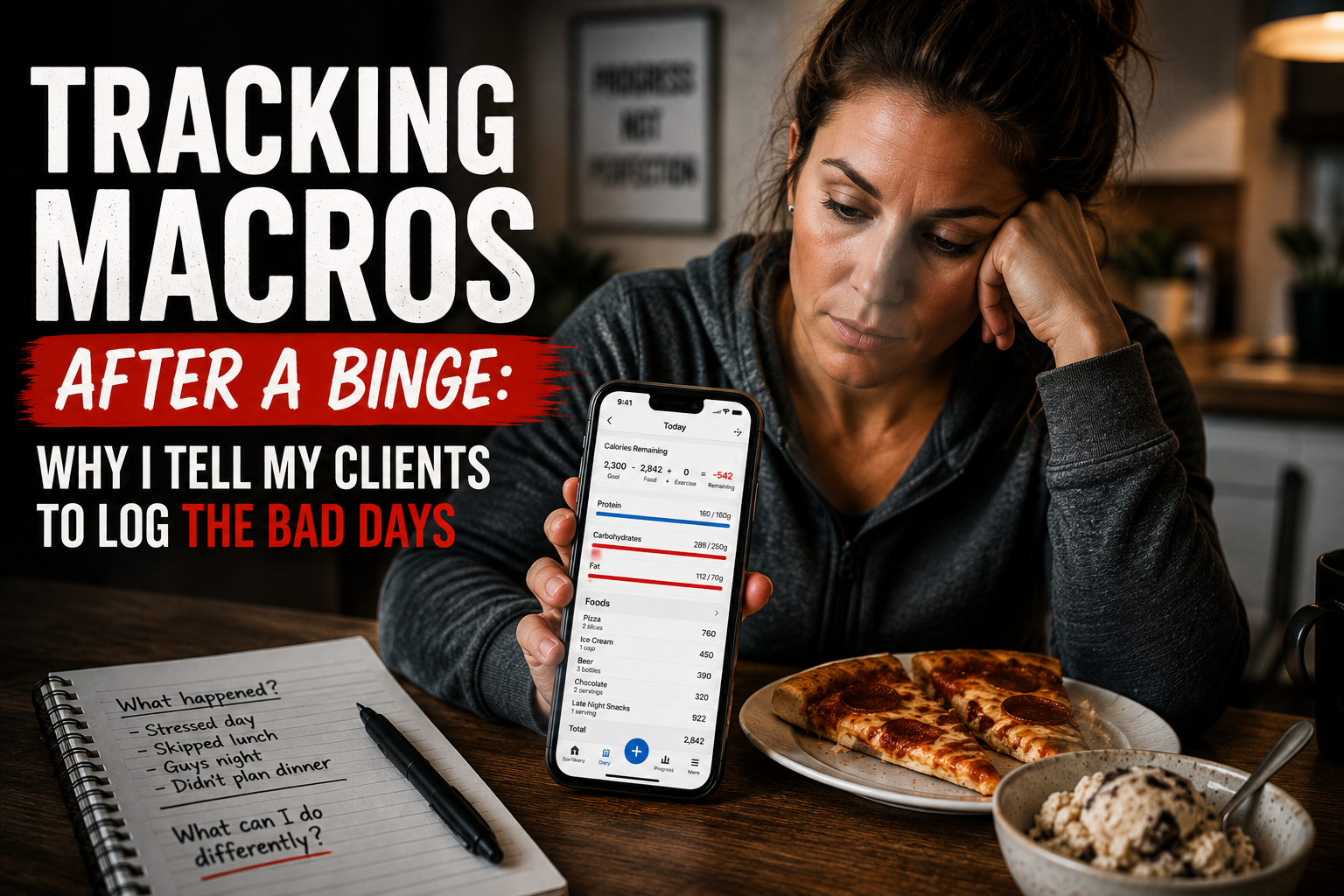
Tracking Macros After a Binge: Why I Tell My Clients to Log the Bad Days
By Anthony Collova, founder of IIFYM.com and creator of the original IIFYM macro calculator. Written from 15 years of one-on-one macro coaching. Reviewed for accuracy and updated for 2026.
One of the first things I ask my clients to do is keep tracking their food when they screw up. Especially when they screw up.
I've coached macros for 15 years, and this one habit separates the people who make steady progress from the people who've been restarting every Monday for a decade.
Most people stop tracking at the exact moment the data matters most
Most people do the opposite of what I ask. They track while they're following the plan, hitting their macros, drinking their water, and feeling good about themselves.
Then comes a night where they eat more than planned, miss their targets, or stop paying attention altogether and write the day off. Perfectionism takes over and the whole thing goes off the rails.
Tracking food after you've already decided to quit for the day isn't easy. Most of my clients don't want to enter the extra food or look at the numbers. Some avoid the app for the rest of the weekend and promise themselves they'll start fresh on Monday.
Closing the app doesn't erase the food
Stopping the log doesn't undo what happened. It only removes your chance to understand it.
When the day is logged, you have something to work with on Monday morning besides guilt. A logged overeating night usually points at one of these:
- You didn't eat enough earlier in the day.
- Dinner wasn't planned.
- You were stressed, tired, hungry, drinking, celebrating, or surrounded by food you don't normally keep in the house.
- The targets were reasonable and the plan you made for reaching them wasn't.
We need the information before we can tell the difference. Without the log, every hard night looks identical, and identical-looking problems get identical guesses instead of real fixes.
Mistakes are how you learn the skill
This is also why I encourage my clients to make mistakes.
I don't tell anyone to overeat or ignore their plan. I know they're going to get things wrong because they're human and they're learning a skill that takes practice.
You can't learn how to handle restaurants without eating at restaurants. You can't learn how to manage weekends by avoiding every social event. You can't learn how to recover from an unplanned meal if every mistake turns into three days of guilt, restriction, and hiding.
The mistake isn't what causes the most damage. Your reaction to it does.
Perfectionism is what actually keeps people stuck
People get so tired of being overweight that they decide perfect or extreme behavior is the only acceptable way forward. Years of frustration get answered with total control. If sloppy got them here, then obsessing over every calorie will get them out.
That works right up until it stops working.
What that approach builds is more pressure, more shame, and more all-or-nothing swinging. None of it is welcome in my program.
The alternative is a path built on clarity, predictability, and enough grace to act like the flawed humans we all are.
What to do the next time you go over your macros
- Track it anyway. Log what you ate as accurately as you can, no matter how far over you went.
- Look at what led up to it. Check the hours before the meal, not just the meal itself.
- Decide whether anything is worth changing. Sometimes the honest answer is nothing.
- Return to the plan at your next meal. The next meal, not Monday.
No punishment. No skipped meals. No attempt to starve the calories back off. No waiting for a fresh week.
Breaking the cycle takes an interruption, and that four-step sequence is the interruption. It works because it removes the two things that turn one meal into one lost week: the blank spot in your data and the story you tell yourself about it.
Grace isn't the same as pretending it didn't happen
Mess up. Own it. Move on.
Grace doesn't mean pretending the mistake didn't happen, and self-forgiveness doesn't mean refusing to take responsibility. This isn't forgive and forget. It's forgive, learn, and apply.
What I expect from clients inside coaching
When you join my program, I don't expect you to hit every target perfectly. I expect you to track, communicate, pay attention, and let me coach you through the parts that don't go according to plan.
Your mistakes give us useful information. They show where the plan needs more structure, where your environment is working against you, where your expectations are unrealistic, and which skills still need practice.
You don't need to prove you can diet perfectly. You need to learn how to keep moving when perfection starts lying to you.
If you don't have macro targets yet, run them through the IIFYM macro calculator. It's the original one, and it's free.
If you want me running the process with you, reviewing your data and making your adjustments, you can apply for coaching here.
Frequently asked questions
Should I log a binge, or just skip the day?
Log it. A skipped day gives you nothing to look at later, so the same pattern repeats with no explanation attached to it. The point of tracking isn't scoring yourself. It's building a record you can read.
How accurate does the log need to be if I've gone way over?
Close enough to see the shape of the day. Estimate portions honestly, log everything including drinks and the food you ate standing at the counter, and move on. An imperfect entry beats an empty one every time.
Should I eat less the next day to make up for it?
No. Go back to your normal macros at your next meal. Cutting food to compensate usually sets up the next episode, because under-eating is one of the most common reasons people overeat in the first place.
How do I know if one night affected my results?
One weigh-in won't tell you. Check weight, measurements, progress photos, and how your goal clothing fits on your regular weekly progress day. A single high scale reading after a big meal is mostly food volume, sodium, and water.
What if this happens every weekend?
A repeating weekend pattern points at structure. Look at how much you're eating Friday afternoon, whether weekend meals get planned at all, and whether your weekday targets are set low enough that the weekend becomes inevitable. That's a plan problem with a plan solution.
Does tracking a bad day make the guilt worse?
For most people it does the opposite once they've done it a few times. The number is usually smaller than the story in their head, and having something concrete to look at tends to shrink the event back down to what it actually was.
Anthony Collova founded IIFYM.com and built the first macro calculator on the internet in 2012. He's spent 15 years coaching flexible dieting clients one-on-one, and has worked with people through fat loss phases, plateaus, reverse diets, hormone changes, and every version of the start-over cycle described above. He writes from direct coaching experience rather than theory.
This article is for general nutrition education. It isn't medical advice, diagnosis, or treatment, and it isn't intended to prevent, treat, cure, or manage any disease or medical condition. Individual results vary based on age, health status, adherence, medication use, hormonal function, and dieting history.
Talk with your physician or licensed healthcare provider before starting any nutrition program, especially if you're pregnant, nursing, taking prescription medication, or managing a diagnosed condition. Don't change or stop medication based on anything you read here. If you're dealing with binge eating, food restriction, or a pattern around food that feels outside your control, speak with a qualified healthcare professional. In the US, the National Alliance for Eating Disorders helpline is available at 1-866-662-1235.