What Hitting Rock Bottom in Addiction Taught Me About Macros and Weight Loss
28 years clean and sober, and I still lean into this tool.
By Anthony Collova, Founder of IIFYM.com
As the founder of IIFYM, I spend a lot of time writing about weight loss, macros, nutrition, dieting and what it actually takes to change your behavior.
Today, I want to talk about something much more personal.
How Do You Know When You've Hit Rock Bottom in Addiction?
I asked that exact question when I was 22 years old and sitting in treatment for drug addiction.
I'm 51 now.
I've been clean and sober for 28 years, and the answer my counselor gave me that day is still one of the most important tools I lean into.
I can still remember exactly where I was when I heard it.
I was 22 years old, sitting in a men's group with eight other alcoholics and drug addicts of all ages.
I was the youngest guy there.
Most of the men were in their 40s, 50s and older.
I'd landed in treatment because I had a DUI, but I didn't think I really had that bad of a problem.
I was mostly there to get my parents off my back.
And if I'm telling the full truth, I fully planned on returning to my same old shenanigans once I got out.
I Thought Rock Bottom Was Somewhere Further Down
During one particular session, I brought up the fact that I'd only had one DUI.
Several of the men in my group had two, three, even four DUIs.
Some had spent time in jail.
They'd lost families, jobs, money, homes and relationships.
They'd gone places I hadn't gone.
So I defiantly threw that in my counselor's face.
"These guys are ready because they've hit rock bottom. Everybody knows you have to hit rock bottom if you want to recover from addiction."
We hear some version of that idea all the time.
Someone loses everything.
Something catastrophic happens.
They finally hit bottom.
Then they change.
So I thought I was being pretty clever when I asked him:
"How do you know when you've hit your bottom?"
I might have two or three more DUIs in me.
As if that were something to brag about.
As if the fact that my life hadn't completely fallen apart yet somehow meant I was doing okay.
The Truth Was That I Was Scared
I wasn't arguing with him because I had some brilliant philosophy about addiction.
I was scared.
Because if I accepted that I had a real problem, I'd have to do something about it.
And if I did what the people around me were telling me I needed to do, I'd have to face my own shit.
I'd have to look inward.
I'd have to face memories of abuse and trauma.
I'd have to look at my inability to live life on life's terms.
I'd have to look at the harm I'd caused other people.
My lack of confidence.
My ineptitude.
My arrogance.
My anger.
My irresponsibility.
All of it combined into one angry pile of irresponsible shit.
There was a part of me that would've preferred another DUI to looking at some of that.
So I asked him again:
"How do you know when you've hit your bottom?"
He took a long, deep breath.
He looked me directly in the eyes.
Then he said something I haven't forgotten in almost three decades.
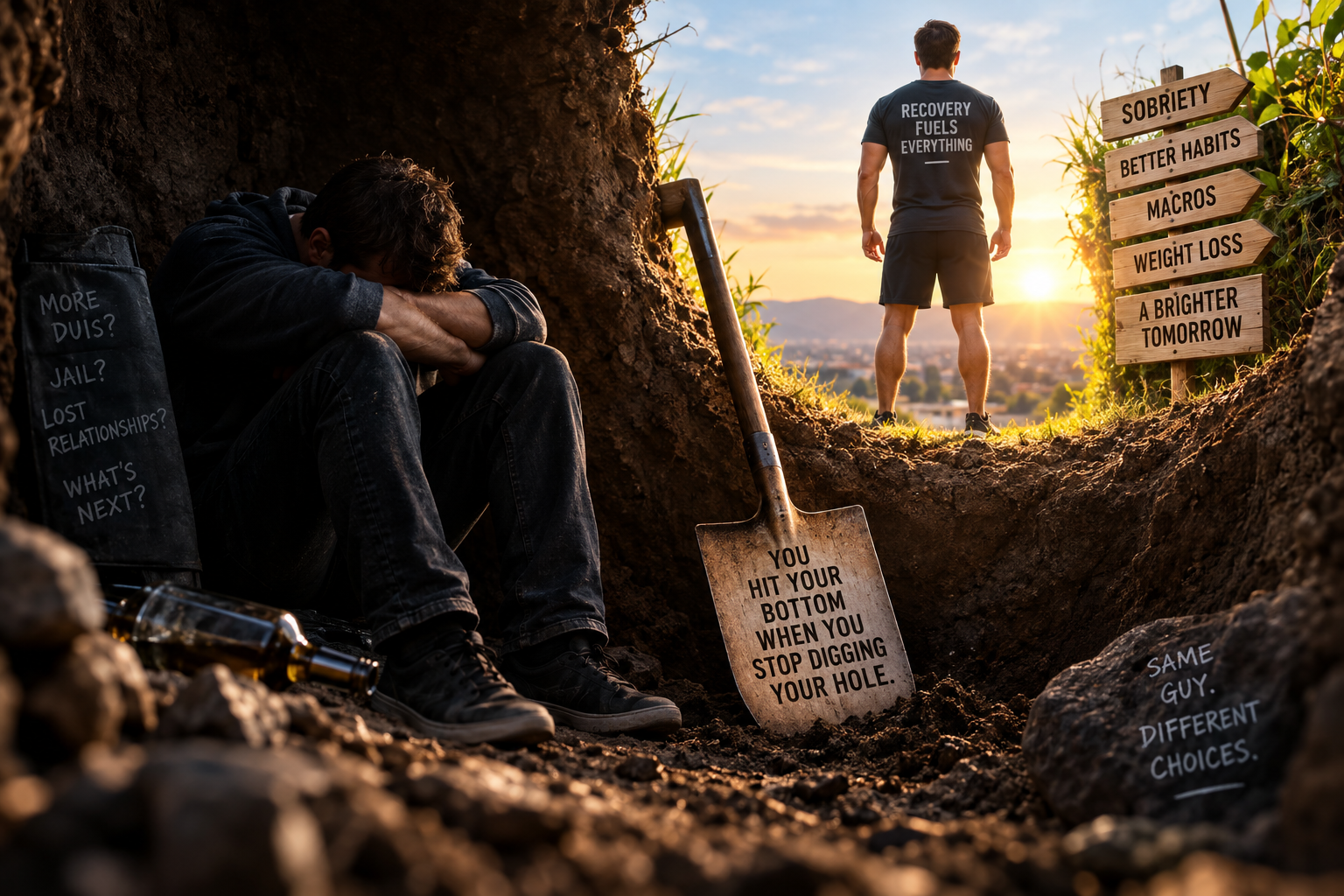
"Anthony, you hit your bottom when you stop digging your hole."
I sat there for probably two full minutes before I said anything.
I could feel the tears welling up in my eyes.
Because for the first time, I understood that I had a choice.
I Didn't Have to Find Out How Bad It Could Get
I didn't have to wait for another DUI.
I didn't have to lose more.
I didn't have to destroy more relationships.
I didn't have to create more consequences before I was allowed to change.
I could stop digging right then.
That's what hit me.
Rock bottom didn't have to be some predetermined location waiting for me at the end of enough suffering.
I didn't have to discover how deep the hole was.
I could put the shovel down.
I could turn around.
I could face the pain of my truth and begin climbing out.
Do You Have to Hit Rock Bottom to Recover From Addiction?
What my counselor told me was personal, but I learned much later that the broader idea holds up too.
The belief that someone has to hit rock bottom before getting help isn't a requirement of addiction recovery.
The National Institute on Alcohol Abuse and Alcoholism specifically identifies the idea that people must "hit rock bottom" before accepting treatment as a misguided assumption.
Their guidance encourages people to make a change sooner rather than waiting for a crisis or greater consequences.
In other words, you don't have to earn recovery by suffering enough first.
My counselor managed to explain that to an arrogant 22-year-old in nine words.
You hit your bottom when you stop digging your hole.
That was the version I could finally understand.
I Had Been Victimized, but I Still Had Choices
Something else shifted for me that day.
I started to understand the difference between what had happened to me and what I was doing with my life now.
I had been victimized.
There were things done to me that I didn't choose.
I didn't cause them.
I didn't consent to them.
And taking responsibility for my life didn't mean taking responsibility for somebody else's abuse.
Those are two very different things.
What changed was my willingness to look at my part in my current suffering.
This was me acknowledging the choices that were mine.
This was me choosing to own the consequences of my addiction in an empowered way.
I couldn't change what had happened to me.
I could decide what I did next.
And while that realization didn't undo the injustices I'd experienced, it helped me see something clearly for the first time.
I was participating in the life I was creating for myself.
The things other people had done belonged to them.
The choices I was making belonged to me.
And everything I'd done up until that point was mine to own.
Ownership Gave Me Somewhere to Go
There's a strange freedom in ownership.
As long as everything was happening to me, I didn't have much power.
The moment I could identify the parts that were mine, I finally had something I could work with.
The sooner I owned my choices, the sooner I could start climbing out of that hole.
I could start living the kind of life I saw other sober people living.
I could start getting some of what they were getting.
I could start showing up for myself in a way I never had before.
That didn't mean beating myself up.
It didn't mean pretending trauma didn't exist.
It didn't mean shame.
It meant responsibility.
There was a path forward now.
I Decided to Become Teachable
From that day forward, I decided I'd become teachable.
I'd listen more than I talked.
I'd pay attention to the people who had something I wanted.
I'd already spent 22 years doing things my way.
I had plenty of evidence for where my way was taking me.
So some part of me decided to lean into what the people around me were offering.
Maybe they knew something I didn't.
Maybe I didn't need to understand every step before I took it.
Maybe I could follow the path for a while and see where it led.
It's been said that the teacher appears when the student is ready.
Maybe part of me was finally ready.
Part of me wanted change.
Part of me wanted the joy, prosperity, abundance and opportunity I saw in people who'd built lives outside addiction.
And part of me was finally willing to let an old version of myself die so something new could take its place.
Recovery Didn't Become Perfect
Stopping digging didn't mean everything suddenly became easy.
It meant I'd made a decision about which direction I wanted to go.
Recovery is still a process.
The Substance Abuse and Mental Health Services Administration describes recovery as an ongoing process of change through which people improve their health and wellness, live self-directed lives and work toward reaching their potential.
Recovery can take many forms. For some people that includes professional treatment. For others it can also involve medication, counseling, peer support, community, faith, family support or other recovery resources.
My path is mine.
Someone else's may look completely different.
I don't think the value of this story depends on everybody recovering the same way I did.
The lesson is much simpler than that.
You don't have to wait for your life to become worse before you're allowed to make it better.
What Hitting Rock Bottom Taught Me About Weight Loss
This is where the lesson follows me into the work I do today.
I've spent years helping people with macros, dieting, fat loss and behavior change.
And I've watched people do something with their weight that feels very familiar to me.
They know something isn't working.
They know they're unhappy with where they are.
They know the way they're approaching food, dieting or their health keeps producing the same result.
But they keep waiting.
Waiting until the scale gets higher.
Waiting until another pair of pants stops fitting.
Waiting for another failed diet.
Waiting until Monday.
Waiting until they're uncomfortable enough to finally do something different.
I don't think you have to hit rock bottom with your weight either.
You don't need another failed diet before you're allowed to change your approach.
You don't need to punish yourself harder.
You don't need to slash your calories lower, pile on more cardio or prove that you can suffer more than you already have.
Sometimes the most important thing you can do is stop digging.
For me, that meant getting sober.
For one of my clients, it might mean admitting that the way they've been dieting for the last five years isn't working anymore.
It might mean becoming teachable.
It might mean asking for help.
It might mean stopping the cycle of restriction, overeating, guilt and starting over.
It might mean realizing that another aggressive calorie deficit isn't automatically the answer every time progress slows down.
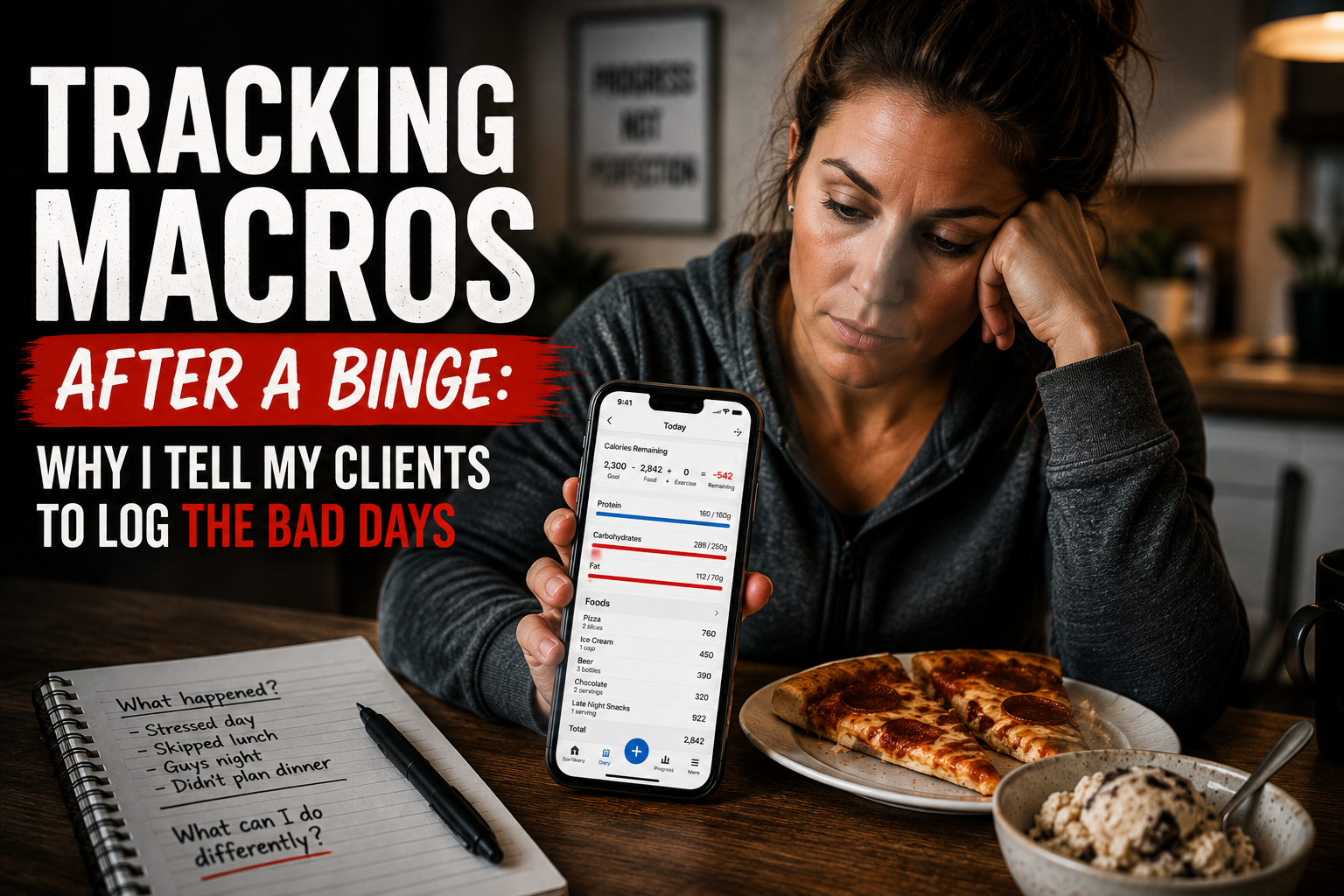
It might mean learning to track your macros without demanding perfection from yourself every single day.
The specific behavior is different.
The underlying question can be remarkably similar.
How much deeper does this hole need to get before I'm willing to stop digging?
You Don't Have to Suffer More Before You're Allowed to Change
Recovery taught me something about behavior change that I still carry into my coaching today.
Change doesn't have to begin when the consequences become unbearable.
It can begin when we're willing to tell the truth about what's happening.
It can begin when we stop defending an approach that isn't working.
It can begin when we become teachable.
It can begin when we stop mistaking suffering for commitment.
This is part of why I don't believe successful weight loss should require someone to approach dieting like it's life or death.
I've seen what life or death actually looks like.
Eating a casserole you couldn't accurately track isn't it.
Going over your macros isn't it.
Having a rough weekend isn't it.
The question isn't whether you executed everything perfectly.
The question is whether you're willing to look at what's happening, learn from it and make a different choice when the old one keeps taking you somewhere you don't want to go.
You don't have to find out how deep the hole goes before you decide to climb out.
You Can Stop Digging Now
I originally thought I didn't have a clever way to tie this story into macros, dieting or weight loss.
Maybe I don't need one.
Because 28 years later, the same lesson keeps showing up in different areas of my life.
Maybe somebody reading this is struggling with addiction.
Maybe somebody is struggling with food.
Maybe somebody keeps starting and stopping the same diet.
Maybe somebody knows something in their life isn't working but keeps waiting for it to become painful enough to finally change.
If that's you, I don't have a sales pitch.
I don't have anything I need you to buy.
I just want to pass along the same words somebody gave me when I was a much younger man:
"You hit your bottom when you stop digging your hole."
You don't have to find out how deep the hole goes.
You can stop digging now.
You can ask for help now.
You can tell somebody the truth now.
You can choose a different direction before another consequence forces you to.
It won't necessarily be easy.
But from where I'm sitting 28 years later, it'll definitely be worth it.
ANT
About Anthony Collova
Anthony Collova is the founder of IIFYM.com. He writes about nutrition, behavior change, sustainable weight loss and his own lived experience with recovery.
Anthony has been clean and sober for 28 years.
Sources and Recovery Resources
- National Institute on Alcohol Abuse and Alcoholism. Make Referrals: Connect Patients to Alcohol Treatment That Meets Their Needs. NIAAA identifies the belief that a person must hit rock bottom before accepting treatment as a misguided assumption. View the NIAAA resource .
- Substance Abuse and Mental Health Services Administration. Recovery and Recovery Support. SAMHSA provides information about recovery and the different pathways people can use to support it. View the SAMHSA recovery resource .
- Substance Abuse and Mental Health Services Administration. SAMHSA's National Helpline. Free, confidential treatment referral and information services are available at 1-800-662-HELP (4357). View the SAMHSA National Helpline .